A Value Object is a domain concept defined by its values rather than by identity. For example, we can represent EventId, EventCode or Email as a value object. In this article, let’s explore the benefits of using value objects over primitive types.
Java, Spring Boot, Microservices, Cloud and DevOps Tutorials
A Value Object is a domain concept defined by its values rather than by identity. For example, we can represent EventId, EventCode or Email as a value object. In this article, let’s explore the benefits of using value objects over primitive types.
As a Java Developer Advocate at JetBrains, I frequently demonstrate IntelliJ IDEA features through videos and articles. To do this, I usually create small demo applications focused on specific features. While this works well initially, the number of such applications grows quickly. Soon, it becomes difficult to remember which app was built for what purpose, turning it into a maintenance headache.
ChatGPT and other Generative AI tools took the world by a storm. People are using these AI tools for various purposes such as to explore a topic, to seek answers to their questions or to get help in coding, etc. ChatGPT and Google’s Gemini are very popular AI tools that are available for free with some usage limitations.
Spring Boot 3.1.0 introduced support for Testcontainers to simplify local development and testing. Testcontainers helps in writing tests using real dependencies instead of mocks, but it may also increase the test execution time.
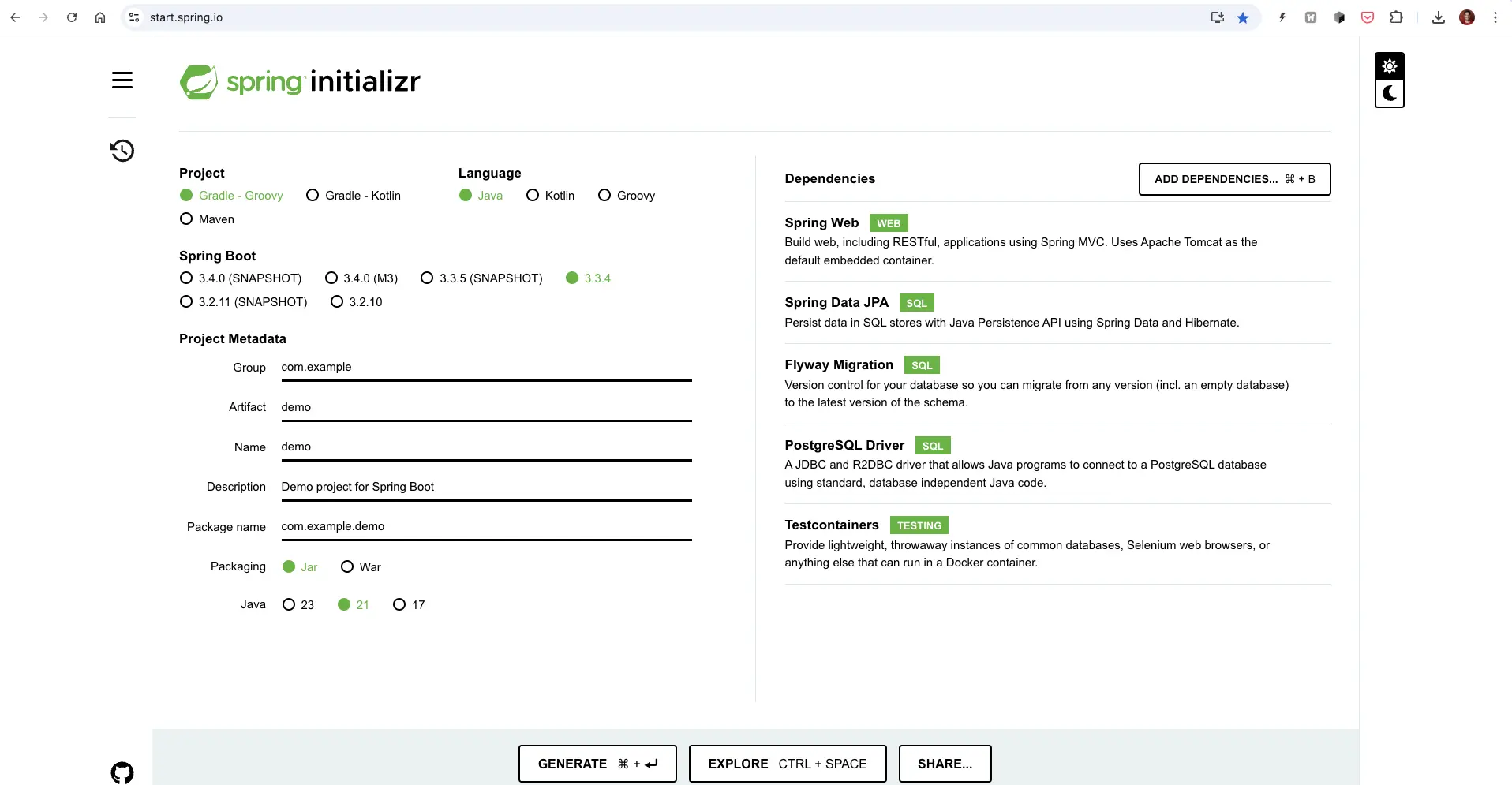
If you ever worked with Spring Boot, then you are probably aware of Spring Initializr. The Spring Initializr is a web application that you can use to create a Spring Boot application.
Do you know Spring Initializr itself is an open-source Spring Boot application? You can fork it, customize it, deploy on your infrastructure and use it to generate Spring Boot applications.
Spring Boot is the most popular framework in the Java world to build enterprise applications. Also, Spring Boot is the most sought-after skill to get hired as a Java developer.
Here is my recommended approach to learn Spring Boot.

Typically, in Spring Boot + Thymeleaf applications, we use thymeleaf-layout-dialect to define the common layout of the web pages and it works fine.
But when we compile the Spring Boot application to GraalVM native image, it is failing due to this error. I tried many suggestions mentioned in the above issue, but none of them worked for me.
In the previous tutorial, we have learned how to fetch One-to-Many relationships using jOOQ. In this tutorial, we will learn how to fetch Many-to-Many relationships using jOOQ.
In the previous tutorial, we have learned how to fetch One-to-One relationships using jOOQ. In this tutorial, we will learn how to fetch One-to-Many relationships using jOOQ.
In the previous tutorial, we have learned how to implement basic CRUD Operations using jOOQ. In this tutorial, we will learn how to fetch One-to-One relationships using jOOQ.