
Spring Boot Tips: Easiest Way To Provide Environment Variables
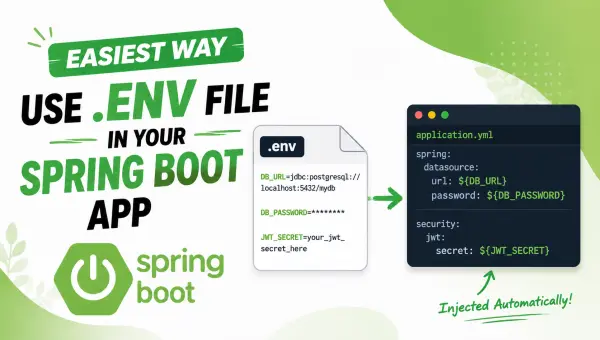
Spring Boot has excellent support for externalized configuration. You can supply configuration through properties files, YAML files, environment variables, command-line arguments, and several other sources.
Spring Boot Configuration Management Best Practices
Explore Spring Boot Configuration Management Best Practices to learn more.
That flexibility is useful, but local development still presents a small annoyance: where should you define environment variables?
You could export them from .bashrc or .zshrc, but then they affect every terminal session.
You could configure them in your IDE, but each run configuration and each developer may need the same setup.
For local development, I usually prefer a small file in the project directory.
Import a local properties file
Suppose the application needs a Telegram bot token and chat ID.
Add the following to application.properties:
spring.config.import=optional:file:.env.properties

telegram.bot-token=${TELEGRAM_BOT_TOKEN}
telegram.chat-id=${TELEGRAM_CHAT_ID}
Then create .env.properties in the project root:
TELEGRAM_BOT_TOKEN=111111111111:ABCJDHRIJFL_NHFjnJKG
TELEGRAM_CHAT_ID=258745896
The spring.config.import property tells Spring Boot to load additional configuration from that file.
The file: prefix means it is read from the filesystem, relative to the directory from which the application is started.
You can also use classpath:.env.properties if you want to place .env.properties in the classpath (ex: src/main/resources).
The optional: prefix is important. Without it, Spring Boot fails to start when the file is missing.
With it, the application can still use environment variables supplied by your IDE, shell, container, or deployment platform.
Prefer the conventional .env name?
Spring Boot normally uses a file extension to determine the configuration format.
Because .env has no recognized extension, add a format hint:
spring.config.import=optional:file:.env[.properties]
The [.properties] suffix tells Spring Boot to parse .env as a Java properties file.
Its contents remain the same:
TELEGRAM_BOT_TOKEN=111111111111:ABCJDHRIJFL_NHFjnJKG
TELEGRAM_CHAT_ID=258745896
This gives every developer one obvious place for local values while leaving production free to provide real environment variables.
One important precaution
These files often contain credentials. Do not commit them.
Add the file you chose to .gitignore:
.env
.env.properties
If teammates need a template, commit an .env.example containing only placeholder values.
That documents the required variables without leaking secrets.
Related Posts
Don't Pollute Your Spring Boot Main EntryPoint Class
Most Spring Boot applications start with a beautifully boring main class. Then one day we need caching. We add @EnableCaching. Then we need async …

A Few Hard Learned Lessons On Structuring Spring Boot Applications
One of the most common questions developers ask when starting a Spring Boot project is: How should I structure my code? If you spend enough time in …

The Power of Value Objects
A Value Object is a domain concept defined by its values rather than by identity. For example, we can represent EventId, EventCode or Email as a value …